



Prefer to Listen? Play this quick summary instead!
Workplace injuries can create uncertainty about your job and what comes next. Many workers receiving compensation start asking practical questions about their employment and future.
If you are leaving a job while on workers’ compensation, you may be wondering whether you can resign, change employers, or be dismissed while still receiving support. You may also question whether your benefits will continue if your employment situation changes.
Australian workers’ compensation and employment laws do allow changes to your job status while you are on claim. However, there are specific rules that affect how payments, obligations, and entitlements are managed.
Read to learn more about what you need to know, whether you can resign, when an employer may dismiss an injured worker, what happens if a role becomes redundant, and how changing jobs may affect your compensation.
💡 REMEMBER!
Employment changes during workers’ compensation can be complex. Understanding the rules helps you make informed decisions about your recovery and work options.
Resigning from a Job While on Workers’ Compensation
Many workers ask if they can resign while on workers’ compensation. In most cases, the answer is yes. You can choose to leave your job even while you are receiving compensation benefits.
Resignation still follows normal employment rules. Notice periods apply and are usually set out in your employment contract, award, or enterprise agreement. In many situations, time spent on workers’ compensation can count toward your notice period.
It is important to understand that resigning does not automatically stop your workers’ compensation claim. You may still receive certain benefits after leaving your job, especially if you continue to meet medical and eligibility requirements.
However, resignation can affect how some payments are calculated. Weekly compensation may change depending on your work capacity and employment status. Your obligations to participate in recovery and return-to-work (RTW) planning will also continue.
Before making a decision, it is often helpful to understand how resignation may affect your specific circumstances.
Can you resign while on workers compensation?
Yes. You can resign while receiving workers compensation. Your claim does not automatically stop, but your payments and obligations may change depending on your situation.
Can You Work a New Job While on Workers’ Compensation?
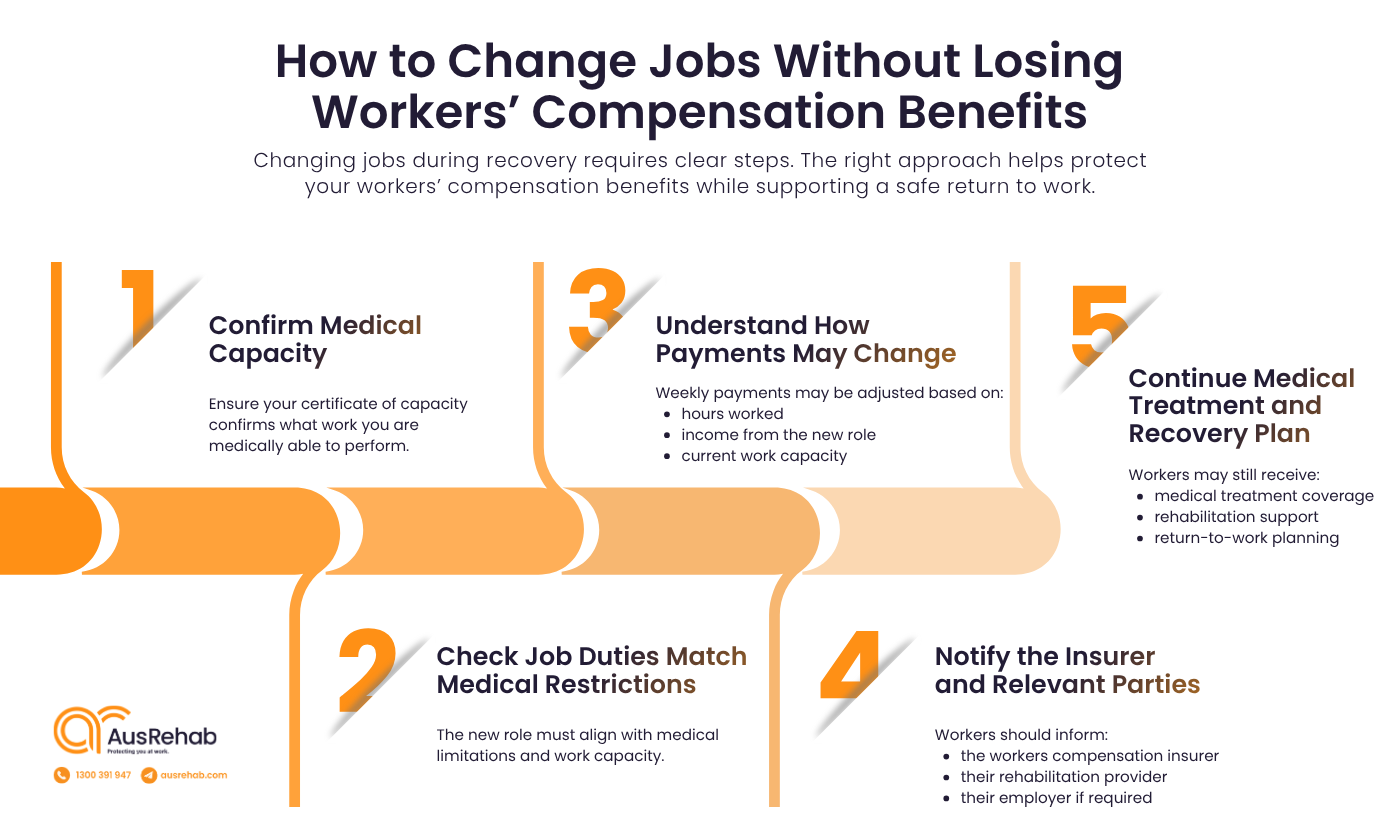
Workers’ compensation systems are designed to support recovery through safe participation in work. If you are medically able, returning to work is usually encouraged as part of your rehabilitation.
This may involve modified duties, reduced hours, workplace adjustments, or a structured return-to-work (RTW) plan. The goal is to match work tasks with your current capacity while you recover.
In some cases, workers consider changing jobs while on workers’ compensation. This can happen for several reasons. Some workers experience limited support from their employer. Others may feel that the available duties are not suitable. Workplace conflict or pre-existing plans to change jobs can also influence the decision.
It is important to understand that the obligation is generally to return to suitable work. This does not always mean staying with the same employer. What matters is that the work aligns with your medical capacity and supports your recovery.
Before starting a new role, it is important to ensure that the job is appropriate for your condition and that your insurer is informed.
💡 To better understand what these modified duties are and why they are important, read our blog on What are Suitable Duties in Workers Compensation?
How Changing Jobs Can Affect Workers' Compensation Payments
If you are changing jobs while on workers’ compensation, your workers’ compensation weekly payments may change. Payments are not fixed. They are based on your work capacity and current employment situation.
Weekly payments are often calculated using your pre-injury average weekly earnings (PIAWE), your current work hours, and your certified medical capacity. When you start a new job, these factors may shift.
Several details can influence how your payments are adjusted. This includes the salary of the new role, the number of hours you work, and when the job change occurs during your recovery. Working more hours or earning more income may reduce the amount of weekly compensation you receive.
Even if your payments change, you may still be entitled to reasonable medical expenses and other benefits related to your injury, depending on your eligibility.
Before making any employment decision, it is important to understand how it may affect your entitlements. Seeking guidance can help you avoid unexpected changes to your payments.
Factors That Can Affect Workers' Compensation Payments
Factors That May Affect Workers' Compensation Payments
| Factor | Why It Matters |
|---|---|
| Pre-injury average weekly earnings | Determines baseline compensation payments |
| Current work hours | Adjusts weekly payment amounts |
| New job salary | May influence benefit calculations |
| Medical capacity | Determines ability to work |
💡 For a detailed explanation on how workers compensation payments are calculated, check out our blog How Long Does Workers Comp Take to Pay.
Do workers' compensation payments stop if you resign?
Not automatically. Payments may continue if you remain eligible. However, the amount may change depending on your income, work hours, and capacity.
Can an Employer Dismiss an Employee on Workers’ Compensation?
Many workers ask if an employer is allowed to dismiss a worker if workers’ compensation is allowed. In Australia, an employer can dismiss an employee who is on workers’ compensation, but strict legal requirements must be followed.
Under the National Employment Standards, the employer must provide written notice of termination. The employee must either work the notice period or be paid in lieu of notice. These requirements still apply even if the worker is not currently performing their usual duties.
In practice, employers may allow the notice period to run while the worker is absent from work. They may also choose to pay the notice period instead of requiring attendance, or use a combination of both approaches.
It is important to note that some employment contracts, awards, or enterprise agreements may include additional protections. These may affect how termination is handled in specific situations.
Dismissal during workers’ compensation is regulated to ensure fairness. The process must follow proper procedures and legal obligations. Read more about this in our blog Can You Fire an Injured Worker?
Redundancy While on Workers’ Compensation
A role can still become redundant while you are receiving compensation. Redundancy while on workers compensation is allowed under Australian employment law, but employers must follow the correct process.
Employers are required to provide proper notice of redundancy. They must also pay redundancy entitlements where these apply under the National Employment Standards, an award, or an employment contract. These obligations remain even if you are not actively working due to your injury.
Consultation is also a key requirement. Employers must discuss proposed workplace changes with the affected employee before making a final decision. This includes explaining the reason for redundancy and considering any reasonable alternatives.
Redundancy does not automatically end your workers compensation claim. If you remain eligible, you may still receive certain benefits after your employment ends.
How AusRehab Supports Injured Workers
AusRehab supports both recovery and a safe return to work after injury. The focus is on practical support that aligns with medical capacity and real workplace demands.
For injured workers, services include job-seeking support, work trial and job placement programs, and career placement guidance. These services help workers re-engage with suitable employment and rebuild confidence during recovery.
For employers, AusRehab provides workplace assessments that identify risks and opportunities for safe task modification. Return-to-work plans are developed to match duties with current capacity. Injury prevention training supports safer work practices and reduces the risk of future incidents.
This combined approach helps workers recover while staying connected to meaningful work. It also helps employers manage injuries in a structured and compliant way.
Support That Helps Injured Workers Return to Work
Employment situations can change during recovery. Understanding how workers compensation interacts with job decisions helps workers move forward with clarity.
Whether you are considering resignation, changing jobs, or managing workplace changes, the right information supports better decisions. Clear guidance and structured return-to-work planning can make the process more manageable for both workers and employers.
AusRehab supports injured workers through rehabilitation services, job seeking assistance, and return-to-work planning that focuses on safe and sustainable recovery.
If you need support navigating your next step, help is available.
Frequently Asked Questions (FAQs)
What happens if you leave your job while on workers compensation?
If you leave your job, your employment ends but your workers compensation claim may continue. Your benefits, especially weekly payments, may be adjusted based on your work capacity and employment status.
Can you work another job while on workers compensation?
Yes. You can work another job if it aligns with your medical capacity. Workers compensation systems encourage safe return to work, even if it is with a different employer.
Can an employer dismiss someone on workers compensation?
Yes. An employer can dismiss a worker on compensation, but they must follow legal requirements such as providing notice and meeting employment standards.
Can your job become redundant while you are on workers compensation?
Yes. A role can become redundant during compensation. Employers must still follow proper processes, including notice, consultation, and redundancy entitlements where applicable.
How are workers compensation payments calculated?
Payments are usually based on pre-injury average weekly earnings, current work hours, and medical capacity. Changes in employment can affect how payments are adjusted.
Do you still receive medical expenses coverage if you leave your job?
In many cases, yes. If your claim remains valid, you may continue to receive coverage for reasonable medical expenses related to your injury.
What should workers consider before changing jobs during compensation?
Workers should consider how the new role aligns with their medical capacity and how it may affect their payments. It is important to understand obligations and inform the insurer before making changes. Guidance from a workplace rehabilitation provider like AusRehab can help ensure a safe and informed transition.
What support helps injured workers return to work safely?
Support may include workplace assessments, graded return-to-work plans, job placement assistance, and coordination with medical professionals. AusRehab provides these services to help workers recover safely and return to suitable work with confidence.
Do different industries use different incident report forms?
Yes. Industries may use different formats based on their risks, environments, and regulatory requirements.